


Thailand: A Unique Culture Amid Giants
- Jack Morton

- Sep 28, 2022
- 2 min read
Thailand is known widely in the west as a tourist's dream. Few that come here (myself included) know much at all about this beautiful country's rich - and at times dark - history. Ideal for travelers due to its iconic scenery, there is much that makes Thailand's culture
unique not only from the rest of Asia, but from other South East Asian nations as well.

Buddhism is by far the most noticeable influence on Thai culture, which isn't at all surprising as the Theravada school was adopted in the region long before Thailand was established or the current Thai people conquered these lands. The piety of the nation becomes clear as you step past several Wats (Buddhist temples) on the same street. The enlightenment-centric religion came over thanks to the edicts of Emperor Ashoka Maurya; an Indian monarch who spread the religion throughout South Asia. As Indian ideas spread East into Thai lands, Buddhism followed. The uniquely Indian elements of Thai Buddhism still shine through in some national symbols, myths, and traditions; most notable of all is the Garuda. The 'King of Birds' - as he is shown above, guarding the hall of the Emerald Buddha in the Grand Palace - remains the national emblem. With this mythological being's roots in Vedic tradition as the vehicle of the Hindu god Vishnu, it is easy to see the shared cultural past between the sub-continent and Thailand.

As Buddha was born in a kingdom just inside what is now modern-day Nepal, his worship highlights Indian influences. Many motifs and murals also show this trade-off from the west. Not all of Thailand's imagery is influenced by Indian tradition, however. As Thailand's indirect northern neighbor, China has also impacted the day-to-day way of life in the south, as well as inspired styles of artwork and architecture. The Guardian Lion above - again from the Grand Palace in Bangkok - shows this Chinese influence. Despite the similarities, this fantastically crafted statue would look incredibly out of place at any heritage site in China.
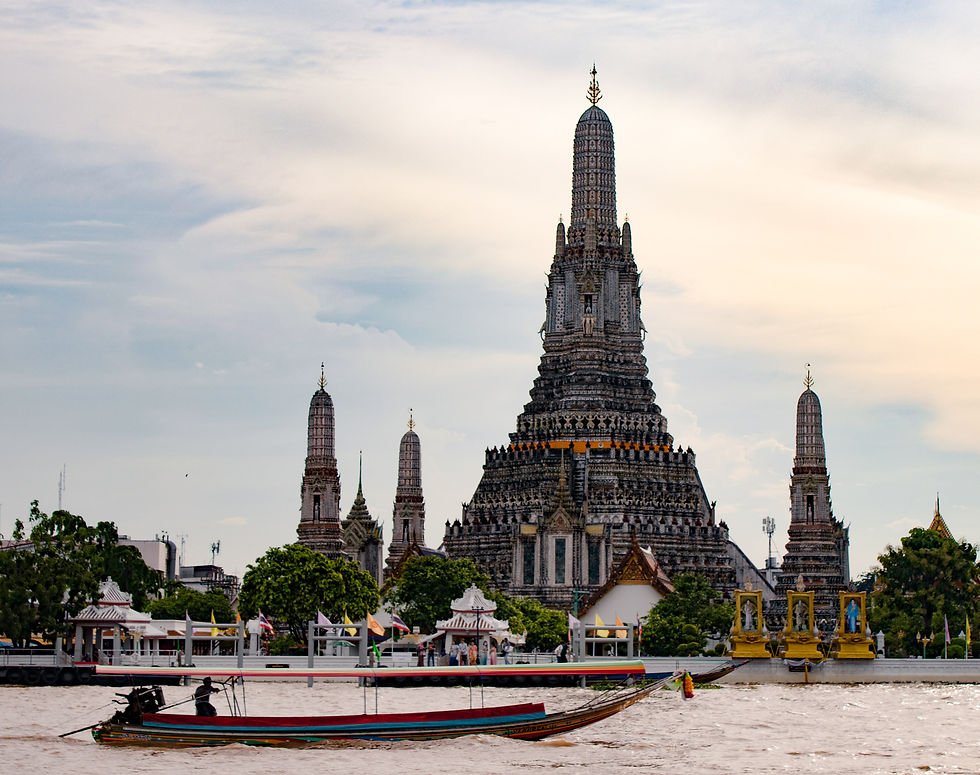
Even with such strong foreign forms present in Thai visual culture, it would be a complete injustice to call it anything but its own style. Despite the clear outside origins of many symbols used throughout the country or intended designs of religious structures, the Thai people have made them their own. There has long been dissatisfaction among scholars who have paid attention to Thailand's history and culture in how the country is perceived by outsiders. The term Sout-East Asia features prominently in this grievance as it implies - as many assume - that Thailand and its surrounding region are nothing more than a blend of Indian and Chinese influences. I can wholeheartedly say having only spent a week in the country that Thai culture and even the nation's form of Buddhism are astonishingly unique and vibrant. While staring directly at Indian inspired structures and Chinese inspired designs, you can't honestly call it anything other than 100% Thai.

Comments